
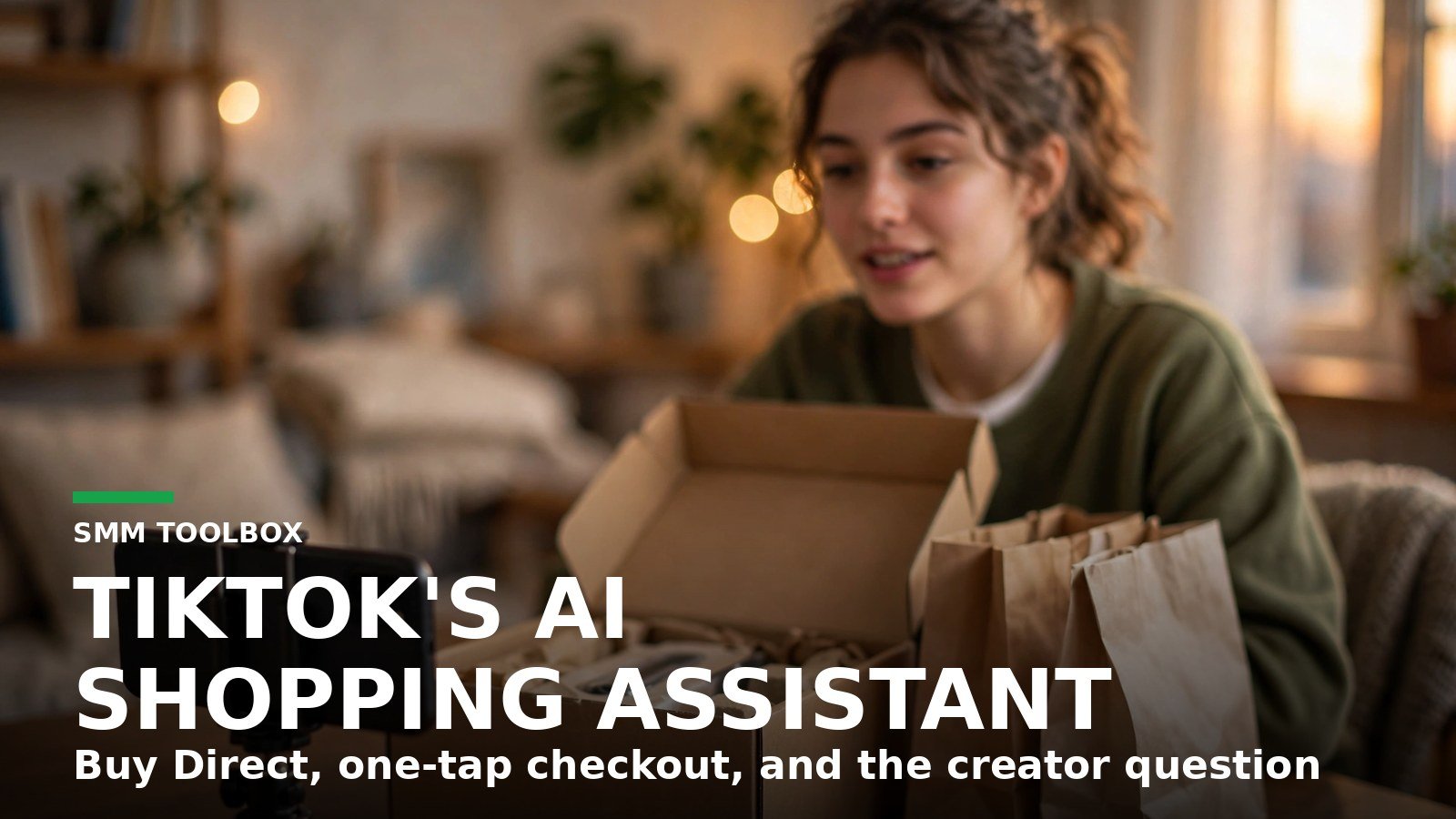
No, TikTok’s new AI shopping assistant does not replace creator recommendations. Not yet, anyway. TikTok announced two tools on 5 October 2026 at Advertising Week New York: Shopping Assistant, a conversational AI agent that answers product questions inside the app, and Buy Direct, one-click checkout straight from the For You feed, according to TikTok’s newsroom. Both are aimed at advertisers first and are offered through eligibility-based testing, with interested advertisers directed to their TikTok sales partner, according to The Keyword, reporting TikTok’s business blog. TikTok has not explained whether or how purchases the assistant influences are attributed to creators or earn them commission. That silence is the whole story for creators right now. The tools are real, the timing is deliberate, and the money question is unanswered.
Why does this land right before Black Friday?
TikTok Shop’s US Black Friday and Cyber Monday campaign runs from 11 to 30 November 2026, according to TikTok News Hub, reporting TikTok’s 14 October newsroom post. That is four days from now. TikTok describes the campaign as bringing shoppers, brands and creators together for one of the year’s biggest shopping moments, according to the same report. TikTok reported that its sales surpassed $500 million during the 2025 four-day Black Friday and Cyber Monday weekend, and that US live shopping sales more than doubled year over year in the first half of 2026, according to TikTok News Hub. The October announcement also leaned on TikTok’s Economic Impact Report, which found that activity on the platform helped generate $81 billion in GDP for US businesses and that 54 million Americans had bought a product after watching a TikTok video, according to TikTok’s newsroom. Read those numbers as TikTok’s own case for why shopping belongs inside the feed, not as independent measurements. The pitch to brands is simple: the shoppers are already here, and now they never have to leave. For creators, the timing is worth noting with a limit attached: the campaign is a major shopping period, but the new tools are in eligibility-based testing for advertisers, and TikTok has not confirmed that every creator video or product gets either feature. A product video posted this month lands in a big shopping window, not in a guaranteed AI-assisted one.
What is TikTok Shopping Assistant?
Shopping Assistant is a chat-style AI agent that answers a shopper’s questions about a product. TikTok describes it as an agent that understands context, remembers what a shopper needs during a conversation, and finds the right products for them, according to TikTok’s newsroom. In practice it appears as a chat window on the merchant’s product page inside TikTok’s in-app browser, according to NudgeNow, reporting TikTok’s business blog. The answers come from information the merchant supplies, according to NudgeNow. Here is the distinction that matters most: the assistant answers questions, it does not check anyone out. After the answers, the shopper continues to checkout on the merchant’s own website, still inside TikTok’s in-app browser, according to NudgeNow. TikTok keeps the two products separate on purpose. Shopping Assistant provides guidance and hands the shopper to the merchant’s checkout. Buy Direct provides the native, in-app checkout. That detail matters for creators because the assistant’s source is the listing, not your video. TikTok has not said how the assistant handles a clash between what a video claims and what the listing says, so treat matching your video to the listing as prudence, not as a documented rule. TikTok is building the experiences with Salesforce, Shopify, Shoplazza and Stripe, according to TechCrunch. The same announcement introduced Agentic Leads, an AI agent that qualifies leads inside TikTok direct messages and in lead forms on advertiser-owned websites, according to TikTok’s newsroom.
How is Buy Direct different from TikTok Shop?
Buy Direct is checkout, not a marketplace. A shopper taps once in the For You feed and buys directly from a brand without leaving TikTok, according to TechCrunch. It is a separate direct-from-brand purchase route beyond the existing TikTok Shop marketplace, which launched in the US in September 2023. TechCrunch puts it plainly: rather than relying on TikTok Shop to drive purchases, TikTok is now integrating shopping tools more directly into the broader app, including the For You feed. The checkout itself is native to TikTok and integrated with merchant systems: one-click purchase using stored payment methods and saved addresses, with in-app order tracking, and the brand stays the merchant of record, according to NudgeNow, reporting TikTok’s business blog. Buy Direct requires an integration with the Universal Commerce Protocol, according to the same report. In plain terms, TikTok is the till, not the shop. eMarketer estimates TikTok Shop generated about $15.8 billion in US sales in 2025, roughly 18 percent of all US social commerce, according to TechCrunch. Buy Direct is TikTok’s attempt to grow beyond that marketplace number by selling from the feed itself.
| TikTok Shop | Shopping Assistant | Buy Direct | |
|---|---|---|---|
| What it is | In-app marketplace | Conversational AI agent that answers product questions | One-click in-app checkout |
| Where it lives | Shop tab and tagged products | Chat window on product pages inside TikTok’s in-app browser, plus other touchpoints | For You feed |
| Who sells | TikTok Shop merchants | No sale inside the assistant; the brand sells through its own site checkout | The brand, as merchant of record, inside TikTok |
| Status | Live in the US since September 2023 | Announced 5 October 2026; eligibility-based testing for advertisers | Announced 5 October 2026; eligibility-based testing for advertisers |
The testing status comes from TikTok’s business blog, as reported by NudgeNow and TheJusGrow. TikTok has named no general launch date, market list or fees for either tool.
How much shorter is the Buy Direct checkout?
Here is the change measured in the smallest unit that matters to a shopper: steps. We counted the steps in two checkout routes from TikTok’s own descriptions of how the flows work. This is our count of an example flow, not a measured average and not a universal sequence, and it leaves the assistant out entirely, because the assistant does not check anyone out. The old affiliate route from a creator video runs about five screens in our example: tap the tagged product, wait for the Shop listing to open, tap buy or add to cart, review the order, then confirm payment and confirm the order. The Buy Direct route is one click from the feed using a stored payment method and saved address, with order tracking inside the app, according to NudgeNow, reporting TikTok’s business blog. The gap between those two routes is the point. Every screen removed is a screen where a viewer used to hesitate, check a comment, or leave the app. The assistant plays a different part: it answers the question that used to send a shopper to the comments or to Google, and then hands them to the merchant’s site checkout. That is why brands will want both tools, and why creators should pay attention. A shorter checkout does not need to be smarter than a creator’s recommendation to change the outcome. It only needs to be faster than the old one.
Will the Shopping Assistant replace creator recommendations?
Not on what TikTok has announced. The assistant answers questions about a product. It does not make the video that makes someone want the product, and TikTok has positioned it as guidance, not as a replacement for creator content. My take is that the risk to creators is narrower and more specific than replacement, and it is a potential risk, not an observed change: the assistant could become the second opinion that overrules the first. A creator can spend a minute explaining why a product fits a particular skin type or room size, and the assistant can answer the same question in one line from the listing. If viewers start treating the listing’s answer as the deciding one, the video’s value could slide from advice toward entertainment. That has not happened yet, and TikTok describes the assistant on product pages in the in-app browser, not as a fixture alongside every creator video, so the risk is conditional on where the assistant actually appears. Three questions decide how far this goes, and TikTok has answered none of them yet. First, does a creator earn commission when the assistant recommends a product they featured, and how is that sale attributed? Second, can a creator or seller pay for, or optimise for, visibility inside the assistant’s answers? Third, when does this leave testing, and which markets get it first? Until TikTok answers the first two, treat the assistant as a brand tool that happens to sit next to your content, not as a new income stream. The one confirmed change that does touch creator money is adjacent: GMV Max, TikTok Shop’s automated ad solution, will now factor in affiliate commissions, coupons and referral fees when optimising spend, according to TikTok’s newsroom. TikTok describes that as optimising for a true return on investment. It has not described a creator-level commission audit, so do not read it as one.
What should creators do before 11 November?
Four moves, all cheap, all before the Black Friday window opens. First, match your video to the listing. Say the same size, price and key detail the merchant’s product page says, because the assistant answers from the page and a mismatch makes your video look wrong. Second, put the product facts on camera in words, not only in text on screen. Say the product name, the price and the one detail a buyer asks about most, so the video itself answers the question the assistant will also answer. Third, keep affiliate links and disclosures exactly as they are. TikTok has announced no change to standard creator affiliate attribution or commission entitlement for assistant-driven purchases, and assuming the assistant will credit you is the one mistake that costs money. The GMV Max change is separate: it folds affiliate commissions into campaign optimisation, which is about how brands spend, not about what creators are owed. Fourth, watch the Seller Center and TikTok’s business blog for the testing to widen, and note the date when it does. The creators who learn the assistant’s answers early will be the ones who know what it tells their viewers about the products they promote.
Is Buy Direct the same as TikTok Shop?
No. TikTok Shop is the in-house marketplace that launched in the US in September 2023. Buy Direct is a separate one-click checkout that lets a shopper buy directly from a brand in the For You feed, with the brand staying the merchant of record, according to TechCrunch.
Can creators use Shopping Assistant yet?
Not generally. TikTok’s business blog describes both Shopping Assistant and Buy Direct as available through eligibility-based testing for advertisers, with access via a TikTok sales partner, according to NudgeNow. TikTok has named no general launch date or market list.
Do creators earn commission when the assistant sells a product?
TikTok has not explained whether or how purchases the assistant influences are attributed to creators or generate affiliate commission. Until it does, assume the assistant is a brand tool, not a new income stream, and keep your existing affiliate arrangements as they are.
When does TikTok Shop’s Black Friday campaign start?
The US campaign runs from 11 to 30 November 2026, according to TikTok News Hub, reporting TikTok’s 14 October newsroom post. Black Friday itself falls on 27 November and Cyber Monday on 30 November.